
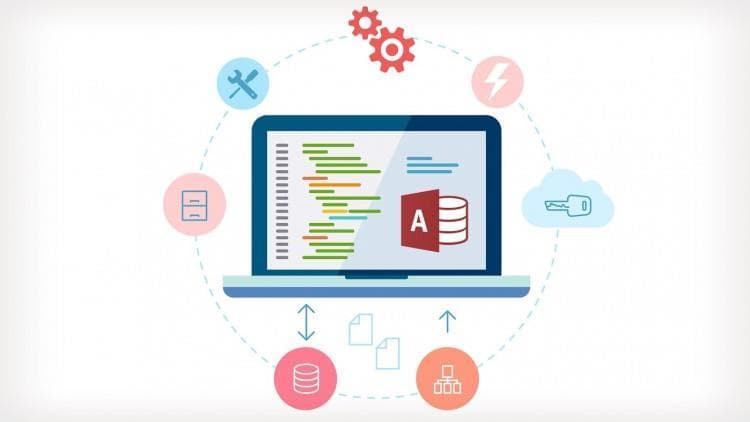
Microsoft Access has been quietly running small businesses for thirty years. It is the database behind more order trackers, job schedulers, and inventory systems than most people would guess — usually built by someone in the business rather than by a software team, and usually still running long after that person has moved on.
This guide covers what Access actually is, what it genuinely does well, where it stops being the right tool, and how to tell which side of that line your own system is on.
What Microsoft Access is
Access is a desktop database that bundles four things most databases keep separate: a place to store data, a way to build screens for entering it, a query tool for pulling it back out, and a report writer. You get all four in one file, and you can build something useful without writing code.
That bundling is the whole reason it spread. A warehouse manager who understands the warehouse can build a working stock system in Access in a weekend. The same person could not build it in SQL Server, and would wait months for IT to do it instead.
Access is part of Microsoft 365 and is included with the Business Standard and Business Premium plans, as well as Office Professional. It runs on Windows only — there is no Mac version and never has been. If you are still deciding between the two, our Access vs Excel comparison breaks down exactly when each one is the right call.
The four things you actually build
Every Access application, however complicated, is made of the same four pieces:
- Tables hold the data. One table per kind of thing — customers, orders, products — with relationships linking them together.
- Forms are the screens people use. This is what separates a database from a spreadsheet: staff enter data through a controlled form rather than typing into raw cells.
- Queries ask questions of the data. Which orders shipped late? Which customers have not bought since March?
- Reports are the printable, shareable output — invoices, pick lists, month-end summaries.
Macros and VBA modules automate the rest. You do not need either to build something genuinely useful, which is precisely why so many Access systems were built by non-developers.
What Access is genuinely good at
Speed of build. Nothing else gets a working data application in front of users as fast. For a process currently held together by spreadsheets and email, Access is often the honest answer.
Data integrity. A spreadsheet lets anyone type anything anywhere. Access enforces types, required fields, and relationships between tables, which stops the slow rot that eventually makes a shared workbook untrustworthy.
Reporting. The report writer is genuinely strong and remains one of the fastest ways to produce a properly formatted, printable document straight from live data.
Pulling data together. Access links to SQL Server, SharePoint lists, Excel files, and ODBC sources, so it works as a front end over data it does not own.
Where Access stops being the right tool
This is the part most guides leave out, and it is the part that matters if you already depend on an Access system.
The 2GB ceiling. An Access database file cannot exceed 2GB. That sounds enormous until a few years of transaction history and embedded attachments accumulate. There is no upgrade path within the file format — when you hit it, you have hit it.
Concurrent users. Microsoft's own guidance tops out around 10 simultaneous users on a shared file, and in practice most businesses see instability well before that. Symptoms are familiar: slowdowns at month-end, lock conflicts, and the occasional corrupted file that needs a repair before anyone can work.
Remote and mobile access. Access was designed for a Windows PC on a local network. It does not work well over VPN, it has no browser version since Access Web Apps were discontinued in 2018, and there is no phone or tablet client. Distributed teams feel this immediately.
Key-person risk. The most common problem we see is not technical. The person who built the system has left, nobody else understands it, and the business cannot change a form or add a field without risking the whole thing.
How to tell which side of the line you are on
Access is still the right tool if your database is comfortably under the size limit, a handful of people use it from one office, and it does the job without regular drama.
You have outgrown it if any of these are true:
- The file needs compacting or repairing to stay usable.
- People outside the office cannot get to it, or get to it painfully over remote desktop.
- You are approaching — or splitting files to avoid — the 2GB limit.
- More people need it at once than it will reliably support.
- Only one person understands how it works, and that person is not on staff.
None of those mean the system was a mistake. They usually mean the opposite: it worked well enough for long enough that the business grew past it.
What happens when you outgrow it
The good news is that an Access database that has been running the business for years is the best possible specification for its replacement. The rules are already worked out, the edge cases are already handled, and the reports are already the ones people actually want. That is a far better starting point than a blank page.
The usual path is to move the data to SQL Server and rebuild the forms and reports as a web application — same logic, reachable from any browser, no user limit, no file to corrupt, and no single person holding all the knowledge. If you are budgeting for that move, our cloud cost calculator gives you a ballpark for what hosting it would run.
We do this conversion regularly, and we start by reading your existing database rather than by asking you to describe it. If you want to know where yours stands, our Microsoft Access services page explains how we work, and a free system review will tell you what it would take to move yours — including if you would be better off leaving it where it is.
Comments
Be the first to comment on this post.