
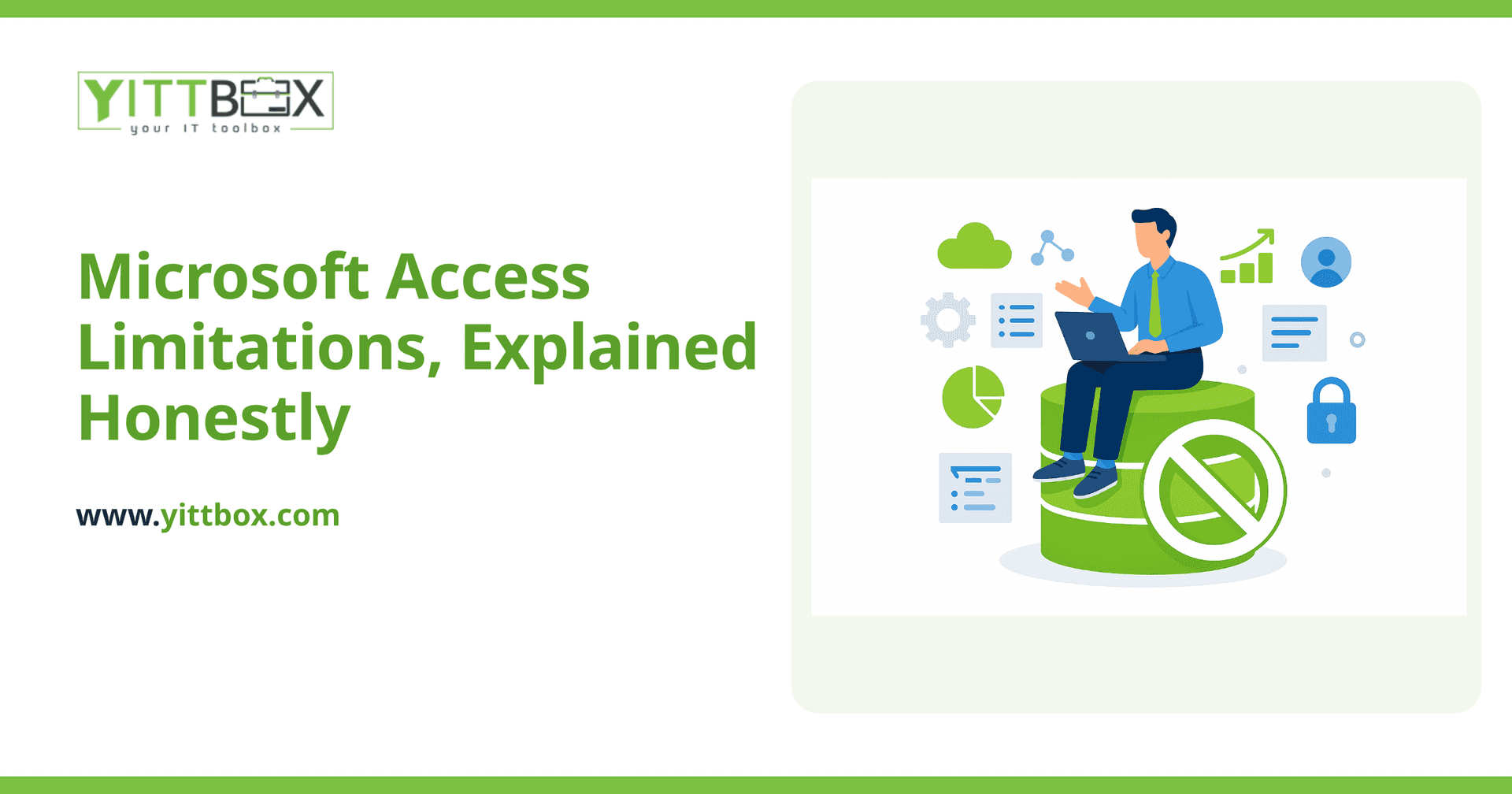
Every platform has limits — the question is whether they're limits your business will ever actually hit. This article lays out Microsoft Access's real technical ceilings plainly, without the vague "Access is outdated" hand-waving you'll see elsewhere, so you can check your own situation against real numbers instead of a vibe.
The 2GB file size limit
An Access database file (.accdb, or the older .mdb format) has a hard ceiling of 2GB — and that includes temporary objects, indexes, and system overhead, not just your visible data. Text-heavy databases (long notes fields, embedded documents) and databases with years of accumulated history hit this well before you'd expect from row count alone. Performance typically degrades noticeably before you hit the literal wall, so a database creeping toward 1.5GB is worth watching, not ignoring until it fails outright.
Concurrent user limits
Access doesn't enforce a hard user-count limit the way it does file size, but real-world stability and performance start to suffer well before any theoretical maximum. The comfortable working range for a database with real write activity is generally under 10 simultaneous users; many databases show real strain somewhere in the 10–20 user range depending on network quality and how well the database is designed (indexing, query efficiency, table structure). Read-heavy databases with light write activity can sometimes handle more; poorly-indexed, write-heavy ones struggle sooner.
Network and remote access limits
Access is a desktop application, full stop. There's no supported way to open an Access database directly from a phone or tablet, and "remote access" typically means either a Remote Desktop session into an office PC, or VPN'ing in — both clunky, and the VPN route reintroduces network-related corruption risk (below). If your team needs to work from multiple locations or on mobile devices, this is usually the limit that bites first, well before file size or user count.
Corruption risk over unstable networks
Access databases accessed over Wi-Fi, VPN, or any less-than-rock-solid network connection are meaningfully more prone to corruption than ones on a stable wired LAN — an interrupted write during a network hiccup can damage the file, sometimes badly enough to lose recent work. This is common enough, and consequential enough, that we cover it in its own dedicated article: Microsoft Access database corruption — why it happens and how to prevent it.
No native audit trail or granular security
Out of the box, Access has no per-record change log (no built-in way to answer "who changed this and when") and no real row-level or field-level security model — anyone who can open the file generally has the same access to the data inside it. Workarounds exist (custom VBA-based logging tables, restricting the shared folder via Windows permissions), but they're bolted-on approximations, not a native capability the way a real database server provides.
Performance limits that aren't officially "limits"
Beyond the hard ceilings above, Access has a set of soft limits that show up as gradually worsening performance rather than a clean failure: queries that were fast on a small table become slow as row counts climb into the hundreds of thousands; forms with a lot of linked lookups get sluggish to open; and reports pulling from multiple related tables can take longer to generate as the underlying data grows. None of these will produce an error message — they just make the database progressively more annoying to use, which is often what actually prompts someone to start asking about alternatives, well before any hard limit is technically hit.
What these limits mean for you
None of these are reasons to panic about a small, well-scoped Access database serving one or two people — plenty of those run fine indefinitely, as covered in what Microsoft Access actually is and where it fits. They matter when your database has quietly become multi-user, business-critical infrastructure that outgrew the desktop-tool assumptions it was built on. If that's your situation, Microsoft Access alternatives compares your real options fairly, and the full modernization guide walks through what to actually do about it.
Is there a way to raise Access's file size limit?
Not directly — 2GB is a hard ceiling of the Jet/ACE database engine itself, not a configurable setting. The practical workarounds are archiving old data out of the active file, splitting the database (keeping only current-need data in the working file), or migrating the back-end to a real database server that has no comparable ceiling.
How many users can Access actually handle before it becomes a problem?
There's no single number that applies to every database — it depends heavily on how much writing (versus just reading) your users do and how well the database is structured. As a practical rule of thumb, treat anything under 10 concurrent users as generally safe, and treat 10–20 as the range where you should actively monitor for slowdowns, lock conflicts, and corruption events rather than assume it'll keep working fine.
Comments
Be the first to comment on this post.