
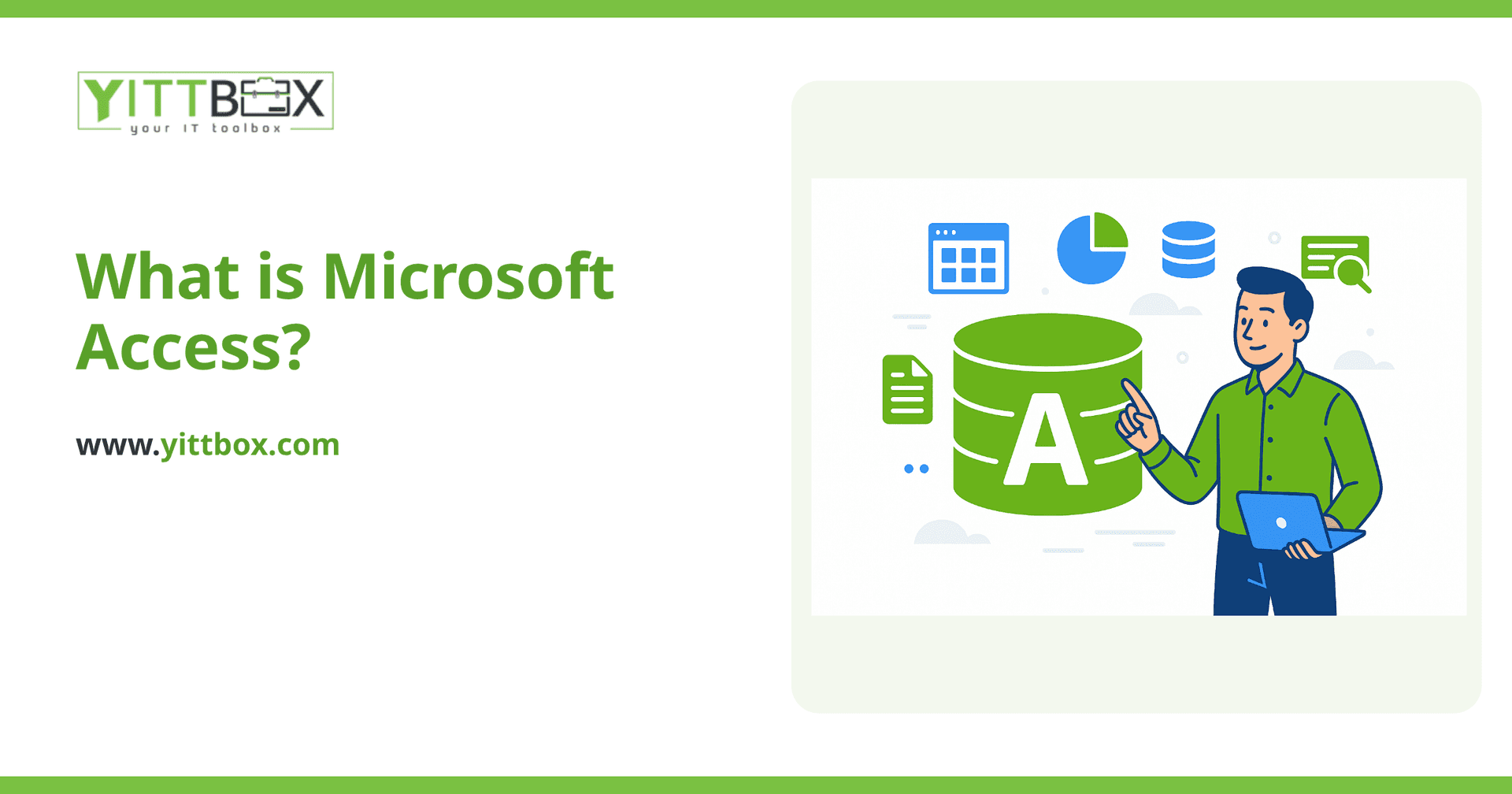
Microsoft Access is a desktop database application that's been part of the Microsoft Office (now Microsoft 365) family since 1992. It lets someone build tables, forms, reports, and simple automation without writing a full application from scratch — which is exactly why it ended up running so many small, essential pieces of business logic that were never meant to become permanent infrastructure.
This article is a plain-English explainer: what Access actually is, what it's genuinely good at, and where — reliably, predictably — it starts to break. If you're trying to figure out whether your business's Access database is fine or a ticking clock, start here.
What Access actually is, technically
Under the hood, Access is two things bundled together: a database engine (called Jet in older versions, ACE in current ones) that stores your data in tables, and a set of design tools for building forms, reports, and queries on top of that data — plus VBA (Visual Basic for Applications), a programming language for adding custom logic like validation, calculations, and automated buttons.
That combination is what makes Access powerful for the right job: one person with no formal software development background can build a genuinely useful, custom application in days rather than months. A relational database, a point-and-click form designer, and a scripting language, all in one familiar Office-family tool.
What Access is genuinely good at
For a small, well-defined problem — tracking inventory for one warehouse, logging customer contacts, managing a simple approval workflow — Access is fast to build, familiar to anyone who's used Excel, and doesn't require hiring a developer or standing up a server. If the whole thing is used by one or two people who understand it, it can run reliably for years.
Where Access reliably breaks
The pattern that shows up again and again: an Access database built for one person's use case quietly becomes load-bearing for a whole team, and the platform's real limits — file size, concurrent-user ceilings, corruption risk on unstable networks, no built-in audit trail or real per-user security, no mobile or remote access — start to matter. None of these limits are a flaw in Access; they're the honest trade-off for a lightweight desktop tool doing a job that's grown past what it was built for.
We cover each of these limits in detail, with the actual numbers, in Microsoft Access limitations, and the specific failure mode most people encounter first — corruption — in why Access databases corrupt, and how to prevent it.
Who actually uses Access today, and for what
Despite its age, Access shows up constantly in specific, recurring contexts: a bookkeeper tracking accounts that don't fit neatly into the main accounting software, an office manager running equipment or asset logs, a small manufacturer tracking work orders and job costing, a nonprofit managing donor and grant records, a law firm tracking matters and deadlines. The common thread isn't the industry — it's a process specific enough that off-the-shelf software didn't quite fit, but not complex enough (at the time it was built) to justify hiring a developer.
That's a legitimate reason to reach for Access, and it's why so many of these databases exist in the first place: they solved a real, specific problem for a real, specific team, often built by someone without a formal programming background using tools designed to be approachable.
Is Access still relevant?
Yes — Access remains part of Microsoft 365 and is actively maintained. The question isn't whether Access is "outdated," it's whether the specific job your database is doing has outgrown what a single-file desktop database was ever designed to handle. Plenty of well-scoped Access databases are exactly the right tool for their job today.
What comes after Access, if you've outgrown it?
If you've read this far because your team's Access database is genuinely straining, the next question is what to move to — and there are more honest options than "just build a web app." We compare them fairly, including when Access itself is still the right call, in Microsoft Access alternatives. For the full picture — Access's limits, your migration options, what a modernization project actually involves, and a free readiness checklist — see the complete guide: The Definitive Guide to Microsoft Access Modernization.
Is Microsoft Access a real database or just a fancy spreadsheet?
It's a real relational database — tables, relationships, keys, and query logic — not a spreadsheet. The confusion is understandable because Excel is often the tool people reach for first, and Access shares Excel's approachable, point-and-click Office design. But structurally, Access enforces data types and relationships the way a database should; Excel doesn't.
Do I need to be a developer to use Microsoft Access?
No — basic table and form building is genuinely accessible to a non-developer. Where it starts to require real skill is in the VBA automation and more advanced query logic, which is also usually where the "only one person understands how it works" risk creeps in.
Comments
Be the first to comment on this post.