
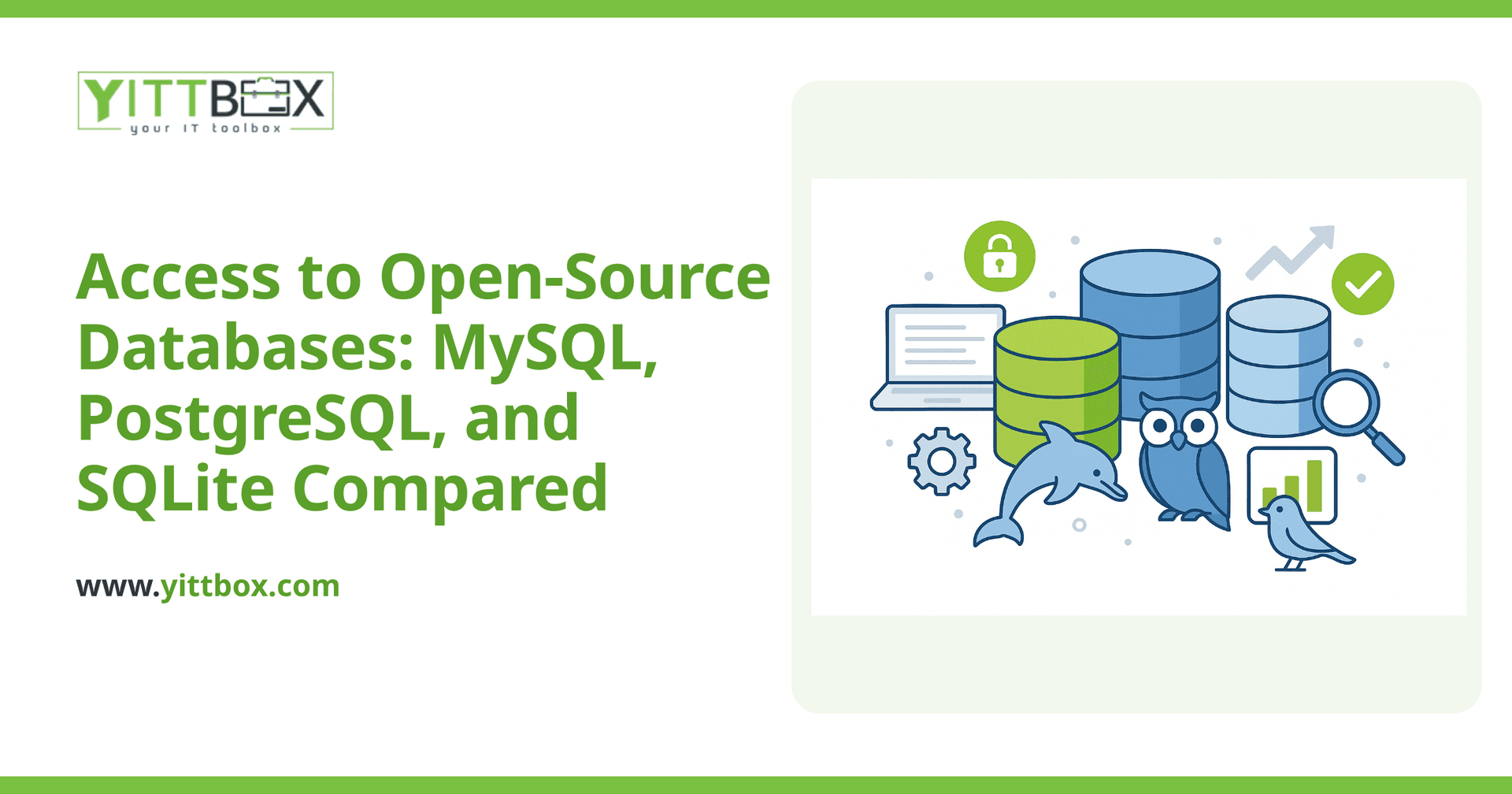
Not every Access migration needs to stay inside the Microsoft ecosystem. MySQL, PostgreSQL, and SQLite are all legitimate targets, each with a genuinely different fit than the other. Here's an honest look at where each one belongs.
This is one of five deep-dives into specific Access migration targets — part of our Microsoft Access Modernization: The Complete Guide. See the others: Access to SQL Server, Access to Azure SQL, Access to Dataverse / Power Apps, Access + SharePoint, and Access to open-source databases.
Why would a business move from Access to an open-source database instead of SQL Server or Azure SQL?
Usually one of a few reasons: licensing cost (SQL Server licensing, while often justified, isn't free), a preference to avoid vendor lock-in to the Microsoft data stack specifically, or because the application being built alongside the migration is already using a particular open-source stack that pairs naturally with one of these databases. None of these are "wrong" reasons — they're legitimate business and technical constraints that point toward a different, equally capable destination.
How does PostgreSQL compare as a target?
PostgreSQL is the closest open-source equivalent to what SQL Server offers for this kind of migration: a full-featured, genuinely enterprise-capable relational database with strong support for complex queries, data integrity constraints, concurrency, and scale well beyond anything Access could handle. It's a strong fit for a business database with meaningful relational complexity — several related tables, real business logic that needs enforcing at the data layer, and a need for the database to keep being reliable as the business and its data grow. It's free to use, with paid managed-hosting options (Azure Database for PostgreSQL, AWS RDS for PostgreSQL, and others) if you'd rather not run and maintain the server yourself.
How does MySQL compare?
MySQL is broadly similar in capability to PostgreSQL for most business use cases, and it's the more common choice specifically when the application layer being built is going into a stack where MySQL is the conventional pairing (a lot of PHP and web-application tooling defaults to MySQL). For a straightforward business database migration, the practical difference between MySQL and PostgreSQL is smaller than either community's advocates tend to claim — both comfortably outclass Access on every dimension that matters for this migration. The decision usually comes down to what the rest of your technology stack already uses, more than a meaningful capability gap between the two.
Where does SQLite fit — and where doesn't it?
SQLite is a different category entirely, and it's important not to confuse it with the other two. It's a lightweight, file-based database — genuinely excellent for a single-application, low-concurrency use case, similar in spirit to Access's own file-based nature, just faster and without Access's specific limitations around size and corruption. What it doesn't solve is Access's biggest structural problem: real multi-user concurrency. SQLite is not built for many simultaneous writers the way MySQL, PostgreSQL, SQL Server, or Azure SQL are. If your Access database's core pain point is "too many people need to use this at once," SQLite is the wrong target — it inherits a version of the same constraint you're trying to escape, just with a higher ceiling.
Do these targets still need a new front end, or can Access stay as the interface?
Unlike SQL Server or Azure SQL, Access doesn't natively link to MySQL or PostgreSQL as cleanly (it requires ODBC drivers and more fragile configuration than the native SQL Server connection), so in practice this migration path is almost always paired with building a new interface — most commonly a custom web application — rather than keeping Access forms as the front end. If keeping the familiar Access interface matters to your team, that's a real point in favor of SQL Server or Azure SQL instead, where the "Access front end, real database back end" pattern is well-supported and common.
How do I choose between PostgreSQL, MySQL, and SQLite?
Choose PostgreSQL or MySQL — either is a strong choice, lean on whichever pairs with your planned application stack — if your Access database has real multi-user concurrency needs and meaningful relational complexity, which describes most business-critical Access databases we see. Choose SQLite only for a genuinely single-user or very-low-concurrency internal tool, where its simplicity and zero-server-management overhead are real advantages rather than a limitation. When in doubt, PostgreSQL is the safer general-purpose choice of the three — it rarely has to be undone later.
Not sure this is the right target for your situation? Our instant estimator asks the right questions and gives you a ballpark, or request an assessment and we'll give you an honest read — including telling you when a different target, or no migration at all, is the right call.
Comments
Be the first to comment on this post.