
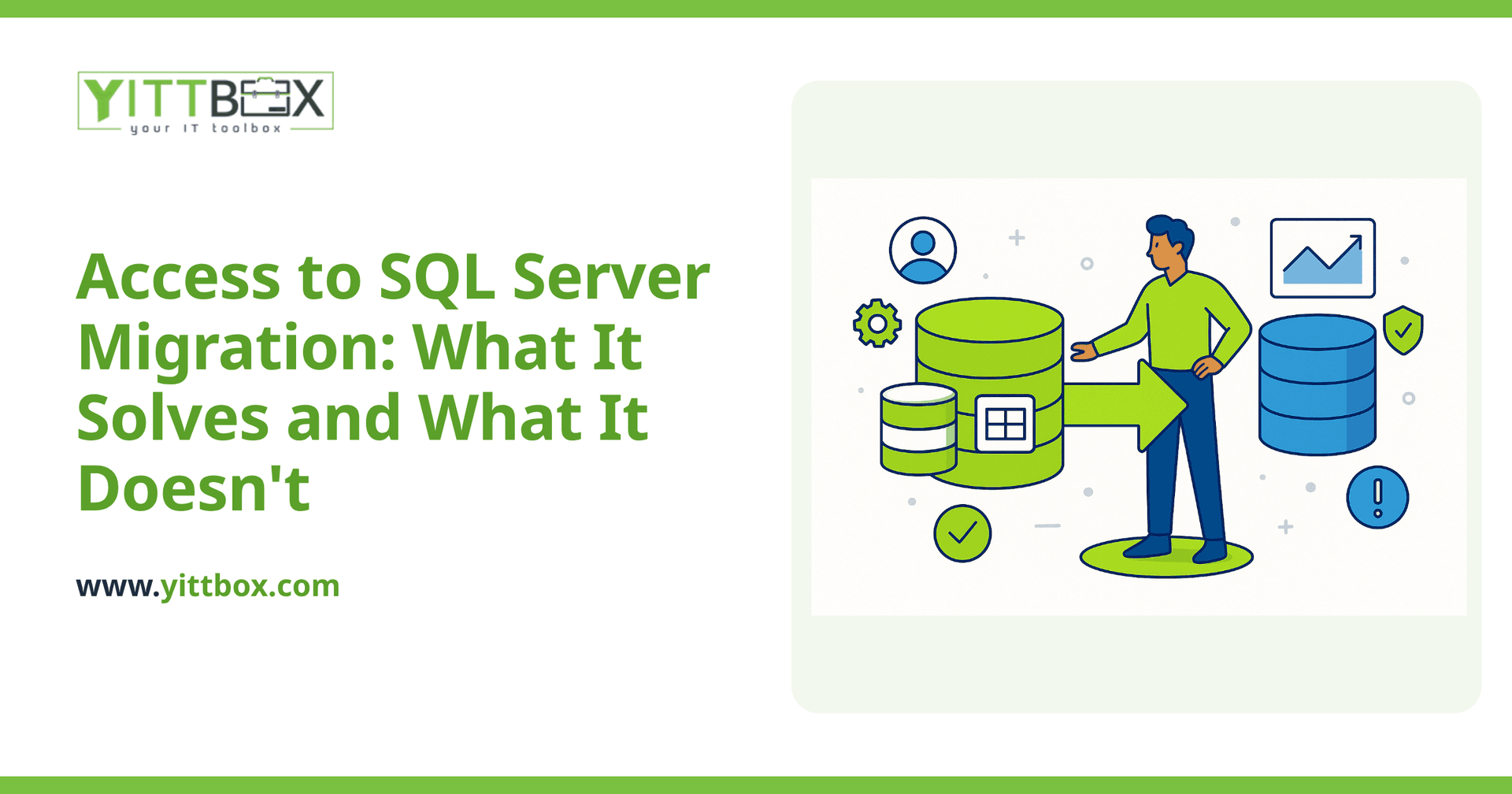
Moving an Access database to SQL Server — often called "upsizing" — is the most direct fix for the data-layer problems that eventually catch up with every growing Access database. It's also, of every migration target, the one most likely to be misunderstood: teams expect it to solve problems it was never going to touch. Here's the honest version.
This is one of five deep-dives into specific Access migration targets — part of our Microsoft Access Modernization: The Complete Guide. See the others: Access to SQL Server, Access to Azure SQL, Access to Dataverse / Power Apps, Access + SharePoint, and Access to open-source databases.
What does an Access-to-SQL-Server migration actually change?
It replaces the data layer. Your tables, relationships, and data move from Access's file-based JET/ACE engine to a real client-server database engine — SQL Server, running on its own server (on-premises or hosted). Access can keep its existing forms and reports as the front end, connecting to the new SQL Server back end instead of the old .accdb/.mdb file. This pattern is common enough that it has a name: an "Access front end, SQL Server back end" split.
What problems does this solve?
Exactly the ones that live in the data layer. The 2 GB file-size ceiling disappears — SQL Server databases scale into the terabytes. Concurrency improves dramatically, because SQL Server is built from the ground up for many simultaneous users writing to the same tables, instead of Access's shared-file locking model that starts straining past a handful of users. Corruption risk drops sharply too: SQL Server manages writes centrally on the server rather than relying on multiple desktop copies of Access all touching the same file over a network share, which is where most Access corruption originates. And you get real backup and recovery tooling — point-in-time restores, transaction logs, scheduled backups — instead of hoping the last manual copy of the .accdb file is recent enough.
What does this migration leave untouched?
The front end. If your team is still using Access forms to interact with the data, they're still bound by Access's own limits: its dated security model, no meaningful row-level security or audit trail, and no clean way to expose the application securely to people outside your office network. Upsizing fixes the foundation without touching the building on top of it — a legitimate strategy if the foundation was genuinely your only problem, but not a full modernization if your team also needs a better interface, remote access, or tighter security controls.
How does the migration actually work?
Every table, relationship, and query gets mapped and moved to SQL Server — not just copied, but reviewed, since this is also the natural point to fix data-quality issues that accumulated over years of ad-hoc use. Your Access front end is then relinked to point at the new SQL Server tables instead of the local file. A responsible migration runs the old and new systems in parallel and reconciles the data until the numbers match, cutting over only once your team has verified it — never a leap of faith where the old file is retired before the new setup is proven.
Who is this the right fit for?
Teams whose forms and reports still work fine for how the business operates, but whose data is the actual constraint — approaching the 2 GB ceiling, regularly hitting lock conflicts with more than a handful of concurrent users, or carrying real risk from a past corruption incident or near miss. If your team has also outgrown the Access interface itself, or needs secure access from outside the office, it's worth comparing this path against SQL Server as a target more broadly and against a full custom web application, which resolves both the data and interface constraints at once.
What does it cost and how long does it take?
Of the four migration targets in this cluster, this is typically the fastest and least expensive — often measured in weeks rather than months, because you're not rebuilding the forms and reports your team already knows. The main cost drivers are how many tables and relationships there are to map, how much of the existing Access querying logic needs to be reworked, and how much data-quality cleanup is needed along the way. Size your own project with our instant estimator.
Is upsizing to SQL Server a permanent fix, or a stepping stone?
It can be either, honestly. For plenty of businesses, an Access front end on a SQL Server back end is a stable, permanent setup — the data-layer risk is gone, and the team is happy with the familiar interface. For others, it's a deliberate first step: fix the more urgent risk now, then modernize the front end into a full web app later once budget or priority allows. Both are legitimate sequencing choices; neither is "doing it wrong."
Not sure this is the right target for your situation? Our instant estimator asks the right questions and gives you a ballpark, or request an assessment and we'll give you an honest read — including telling you when a different target, or no migration at all, is the right call.
Comments
Be the first to comment on this post.